Decorative Quartz Flooring Kits – Shop by Color and System
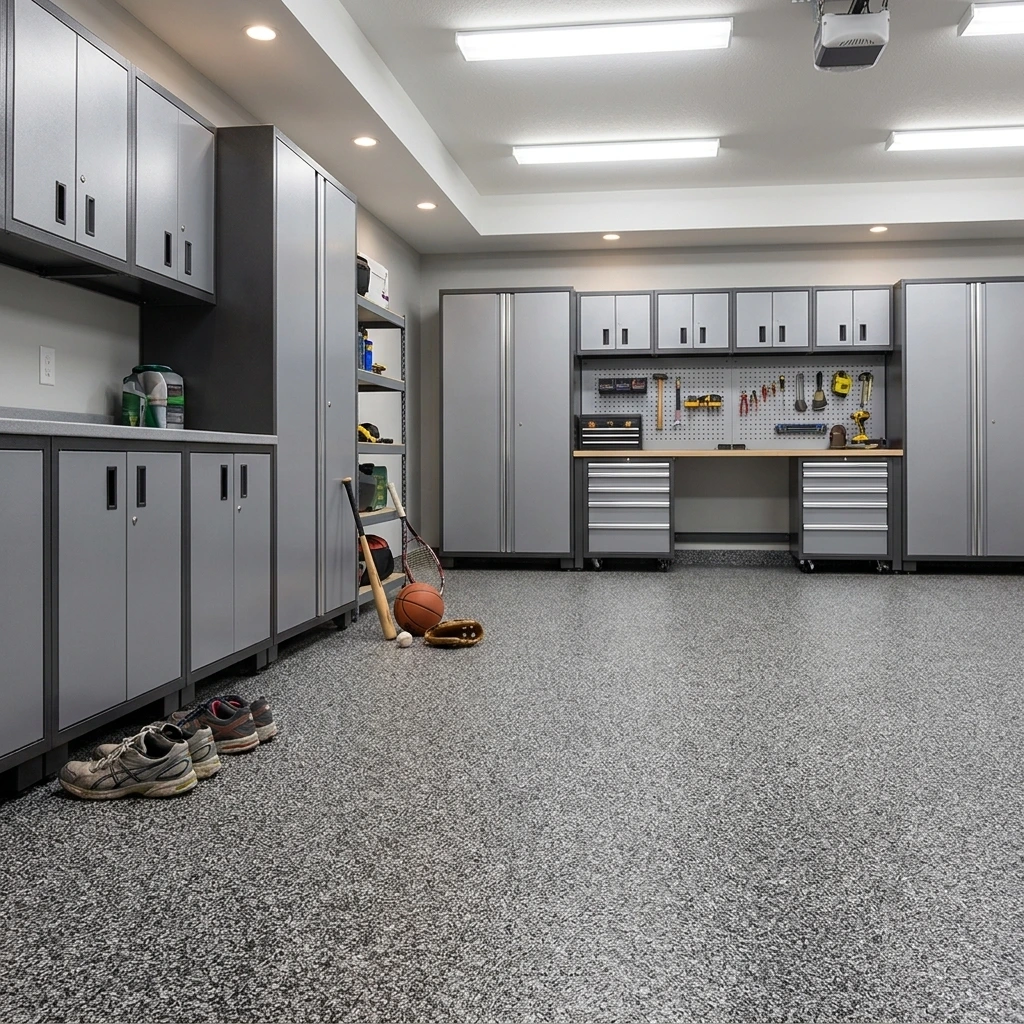
1 Day Quartz Flooring Systems
- Polyaspartic 85 Base Coat — Tinted with RZ Tint and applied at 150 sq ft/gal. Mixed at low speed for 30-60 seconds. Pour in ribbons across the floor and spread with a notched squeegee and ¼” nap roller.
- RZ Tint — Added directly to the resin before application. Recommended dosage is 4 oz per gallon of resin. Always add tint after mixing the resin, never before.
- Decorative Quartz Broadcast — Applied at 1 lb per sq ft in two passes, throwing in opposite directions each pass. First pass is 60% of total material, second pass brings it to rejection.
- Top Coat — Applied after quartz cleanup at 125 sq ft/gal. Polyaspartic 85 is recommended as the top coat for UV and abrasion resistance. Recoat window is 4-6 hours after base coat.
- Complete in 1 Day — With no primer coat, total labor is 4.5-14.5 hrs with a 4-8 hr wait between coats. The entire project can be done in one to two days.
2-3 Day Quartz Flooring Systems
- Epoxy HP Base Coat — Tinted with RZ Tint and applied at 150 sq ft/gal. Mixed at low speed for 3 minutes. Epoxy has a longer working time on the concrete surface making it more forgiving for DIYers — you have more time to spread and correct before it sets.
- RZ Tint — Added directly to the resin after mixing. Recommended dosage is 4 oz per gallon of resin. Always mix the resin first, then add tint.
- Decorative Quartz Broadcast — Applied at 1 lb per sq ft in two passes, throwing in opposite directions each pass. First pass is 60% of total material, second pass brings it to rejection.
- Polyaspartic 85 Top Coat — Applied after quartz cleanup at 125 sq ft/gal. Polyaspartic is the recommended top coat for UV and abrasion resistance, ensuring your floor won’t yellow over time even in a garage with natural light exposure.
- Complete in 2-3 Days — With no primer coat, total labor is 4.5-14.5 hrs with a 10-18 hr wait between coats. The slower set time of epoxy lets you spread the work comfortably across two to three days while the bonding window stays open.
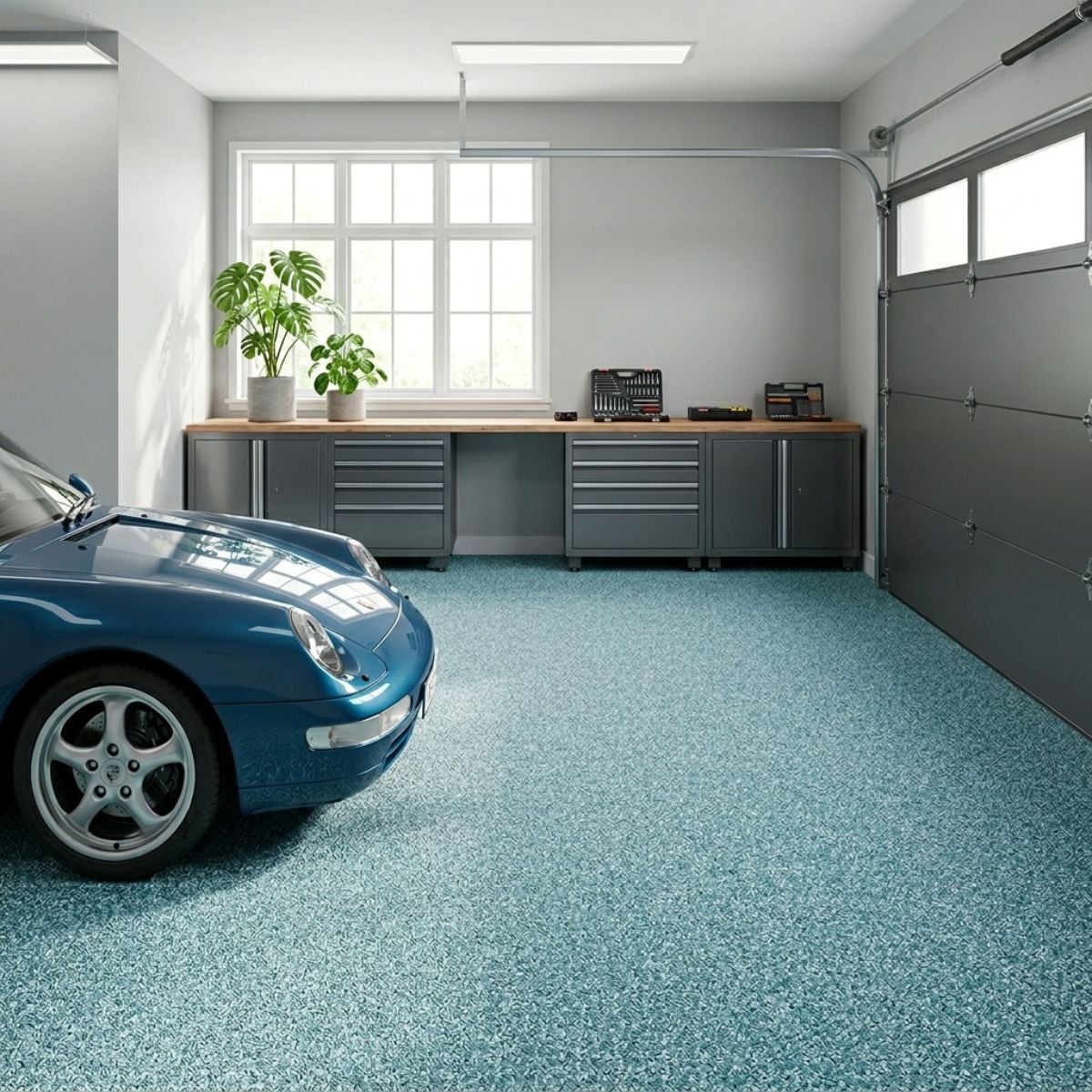
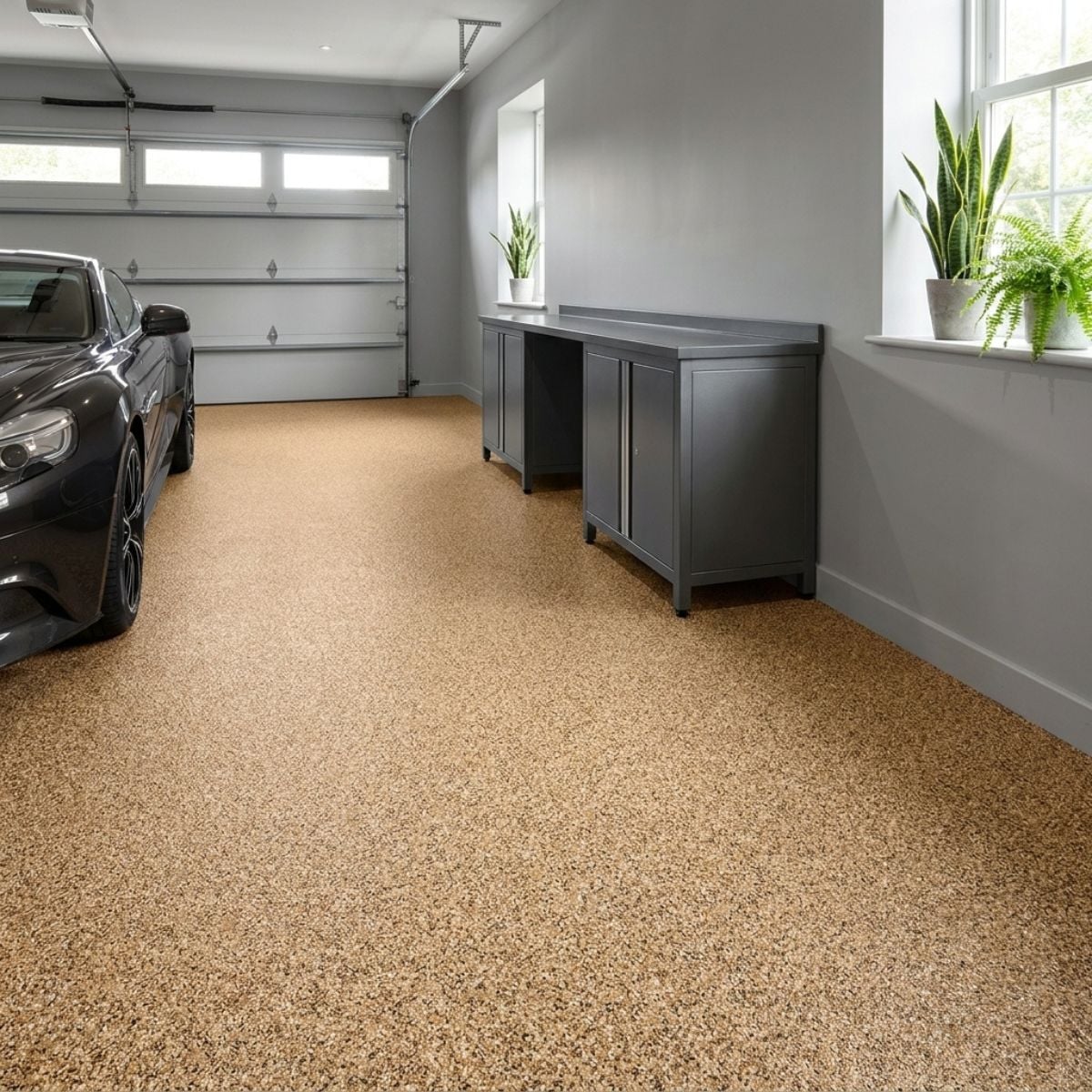
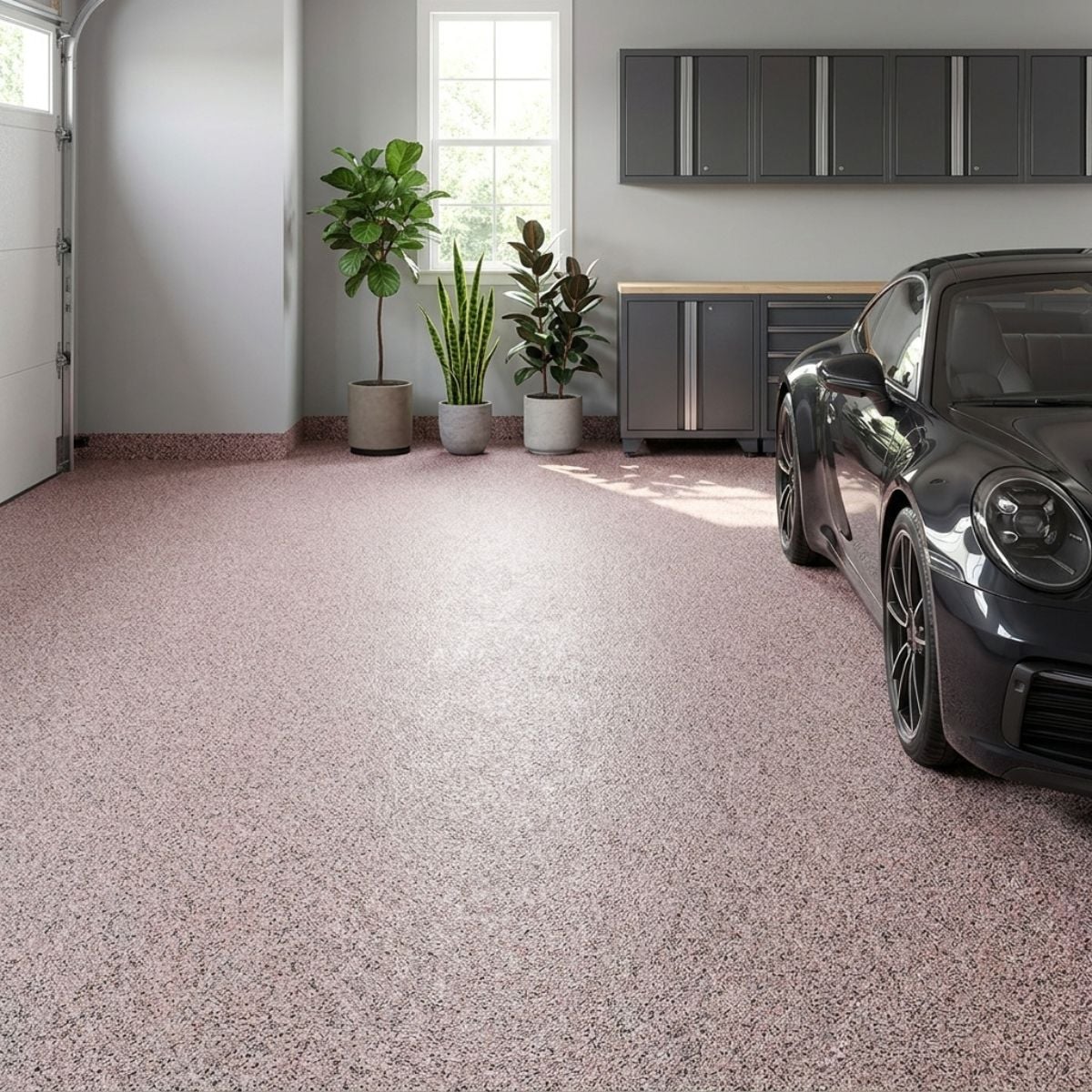
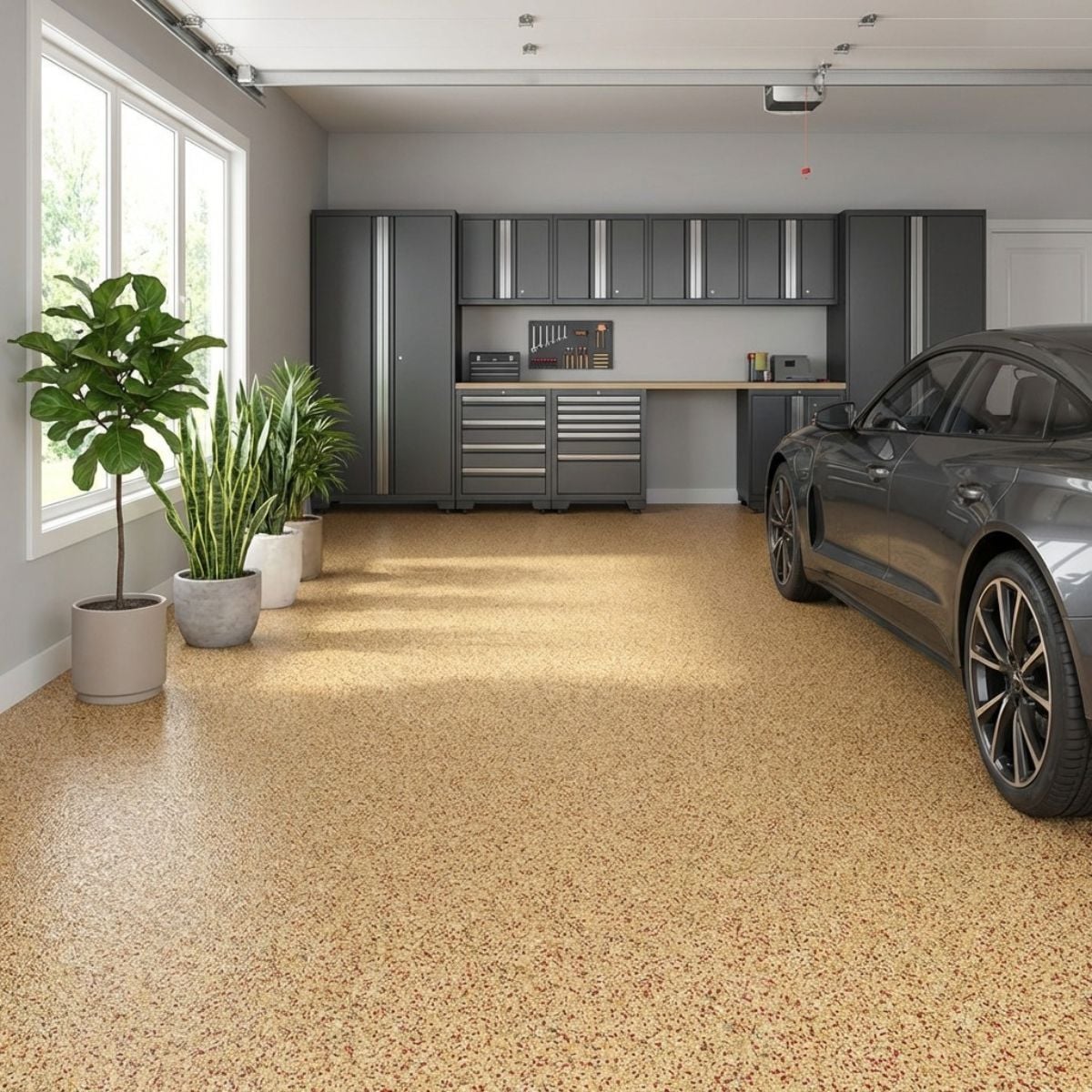
Pro Grade Quartz Flooring Systems — AU 85 Top Coat
- Choose Your Base Coat — Select Polyaspartic 85 for a 1-day install with a 4-6 hour recoat window, or Epoxy HP for a more forgiving 2-3 day system with longer working time on the concrete surface. Both deliver the same coverage and can be tinted to any color.
- Primer Coat (Recommended) — A thin primer coat seals porous concrete, eliminates air pockets that cause bubbling, and provides moisture protection. If your concrete looks like swiss cheese after grinding, primer is essential. With primer, your base coat covers 175 sq ft/gal instead of 150 sq ft/gal.
- RZ Tint Base Coat — Added to the resin after mixing at 4 oz per gallon. Always mix the resin first, then add tint. Pour material in ribbons across the floor and spread with a notched squeegee and ¼” nap roller.
- Decorative Quartz Broadcast — Applied at 1 lb per sq ft in two passes throwing in opposite directions. First pass uses 60% of material, second pass brings it to rejection. Sweep and vacuum excess before applying top coat.
- AU 85 Aliphatic Urethane Top Coat — The highest performance top coat available. Formulated to allow thicker coats without foaming and delivers superior UV, abrasion, chemical, and oil resistance. Longer working time makes it the most DIY-friendly top coat option. Applied at 125 sq ft/gal on quartz floors.
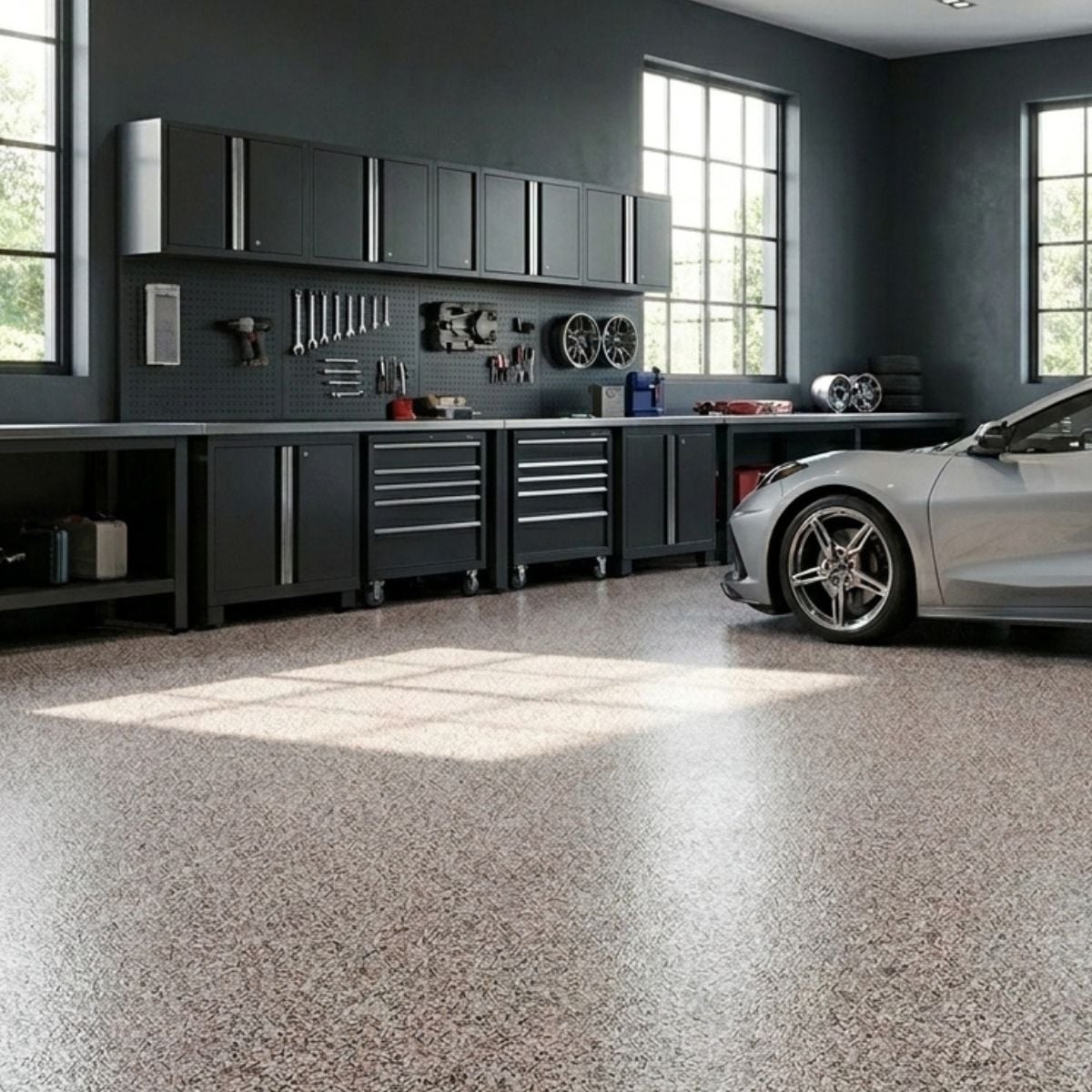
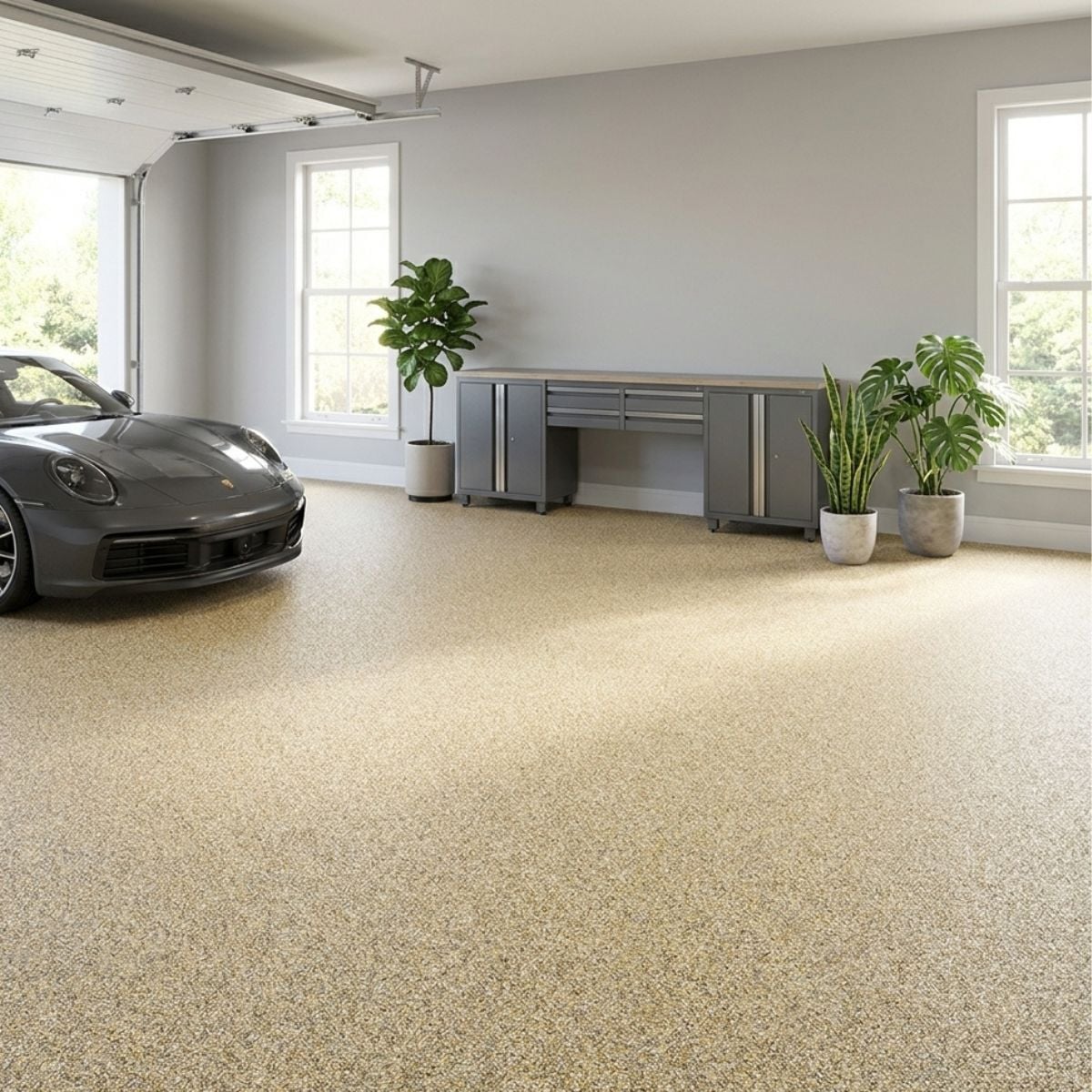
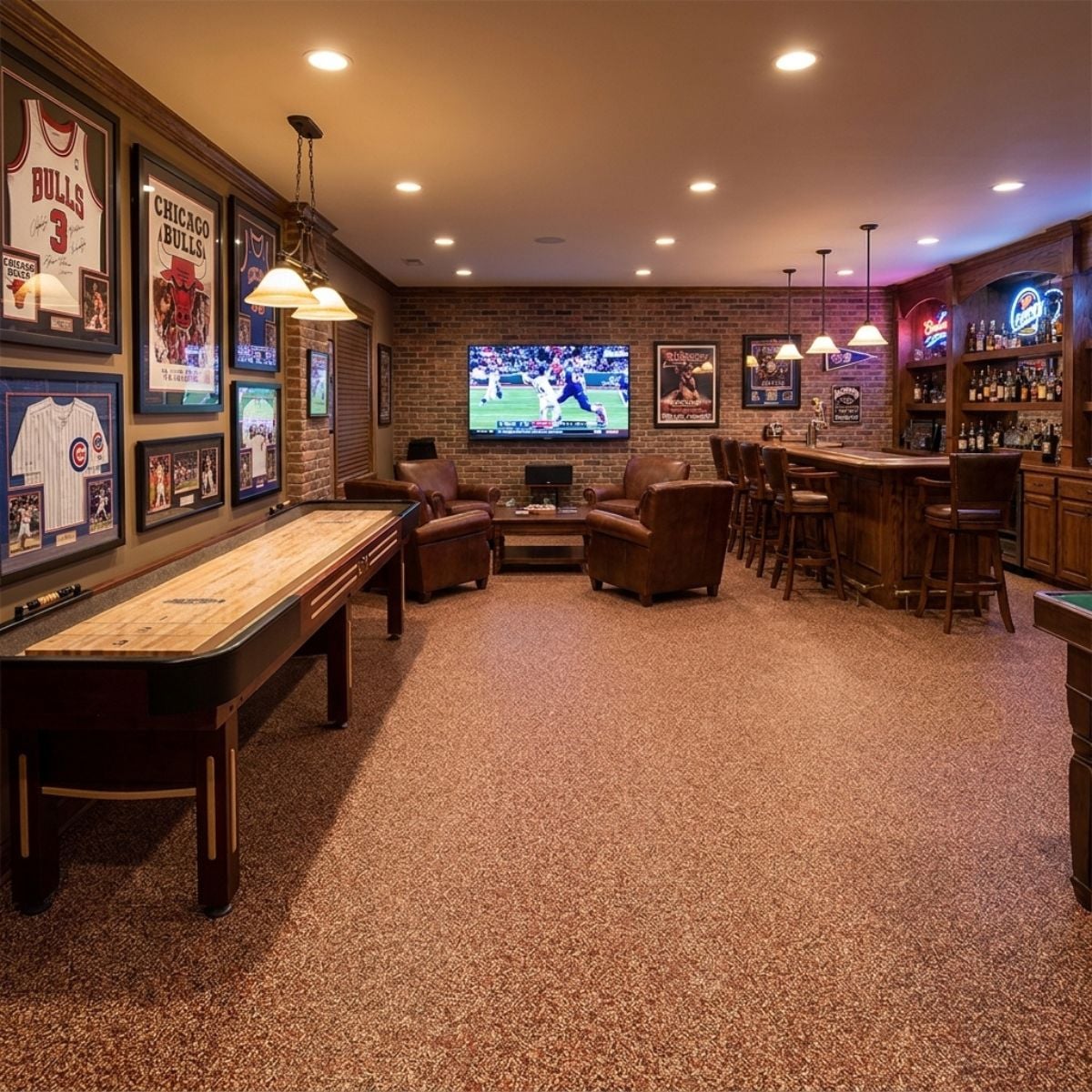
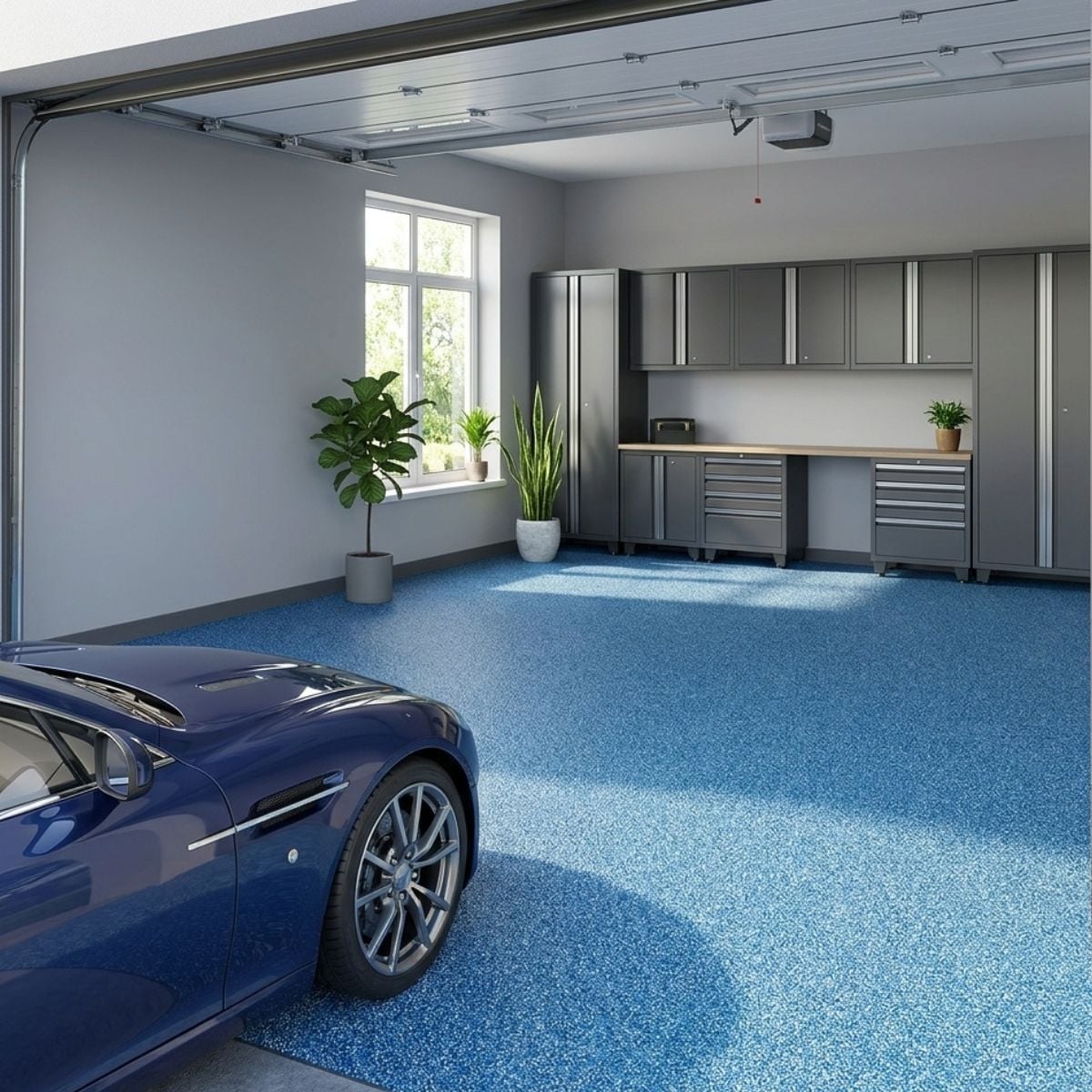
Decorative Quartz Floor Coating Kits — Full System Overview
Every kit on this page is a complete quartz floor coating system — resin base coat, decorative quartz broadcast, RZ tint pigment, and top coat — engineered for either DIY garage floors or professional installations. The table below summarizes each look, the materials involved, coverage rates, and estimated starting cost for a 1-car garage (300 sq ft) with no primer coat. Use the galleries above to open the full kit builder for any look.
| Look | System | Quartz Color | RZ Tint | Coverage Rates | Timeline | Starting Price* |
|---|---|---|---|---|---|---|
| 1-Day Polyaspartic Quartz Floor Systems — Polyaspartic 85 Base Coat + Polyaspartic 85 Top Coat | ||||||
| Black / Black Granite | Polyaspartic 85 (base + top coat) | Black Granite | Black | Base coat: 150 sq ft/gal · Top coat: 125 sq ft/gal · Quartz broadcast: 1 lb/sq ft | 1 Day | From $779 |
| Dark Gray / Sandalwood | Polyaspartic 85 (base + top coat) | Sandalwood | Dark Gray | Base coat: 150 sq ft/gal · Top coat: 125 sq ft/gal · Quartz broadcast: 1 lb/sq ft | 1 Day | From $779 |
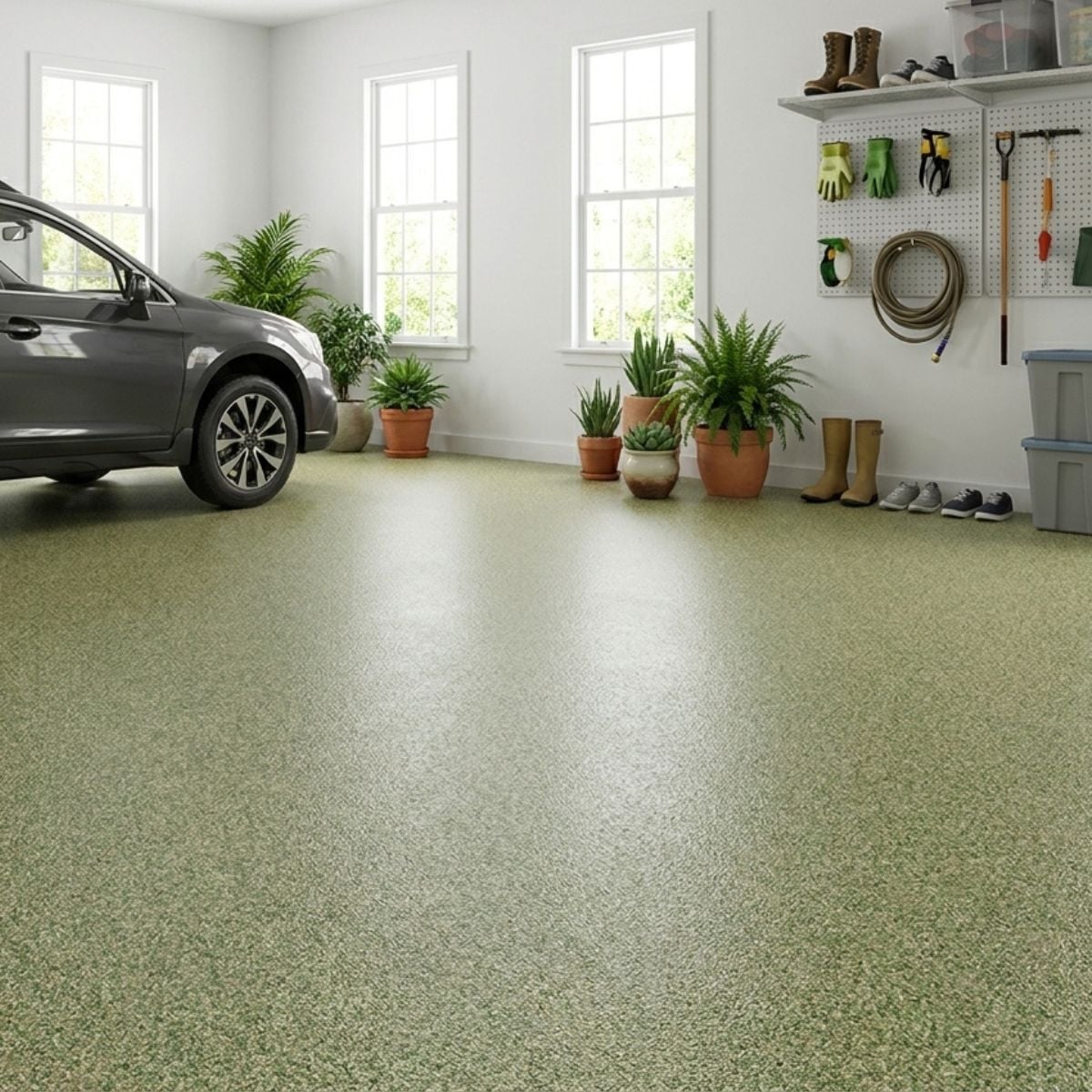
| Emerald / Southern Moss | Polyaspartic 85 (base + top coat) | Southern Moss | Emerald | Base coat: 150 sq ft/gal · Top coat: 125 sq ft/gal · Quartz broadcast: 1 lb/sq ft | 1 Day | From $779 |
| White / Bluestone | Polyaspartic 85 (base + top coat) | Bluestone | White | Base coat: 150 sq ft/gal · Top coat: 125 sq ft/gal · Quartz broadcast: 1 lb/sq ft | 1 Day | From $779 |
| 2–3 Day Epoxy Quartz Floor Systems — Epoxy HP Base Coat + Polyaspartic 85 Top Coat | ||||||
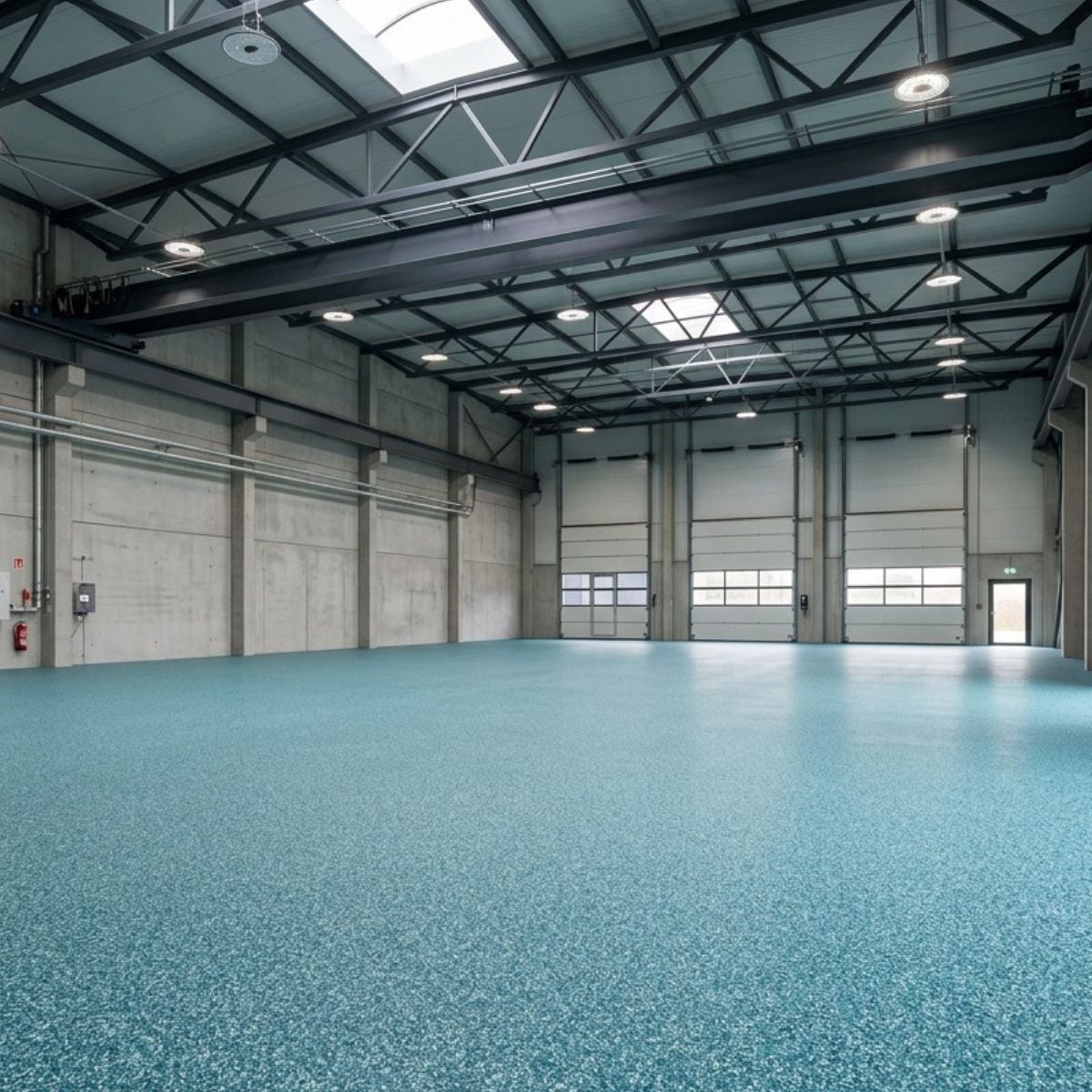
| Light Gray / Aqua | Epoxy HP base coat + Polyaspartic 85 top coat | Aqua | Light Gray | Base coat: 100 sq ft/gal (150 with primer) · Top coat: 125 sq ft/gal · Quartz broadcast: 1 lb/sq ft | 2–3 Days | From $800 |
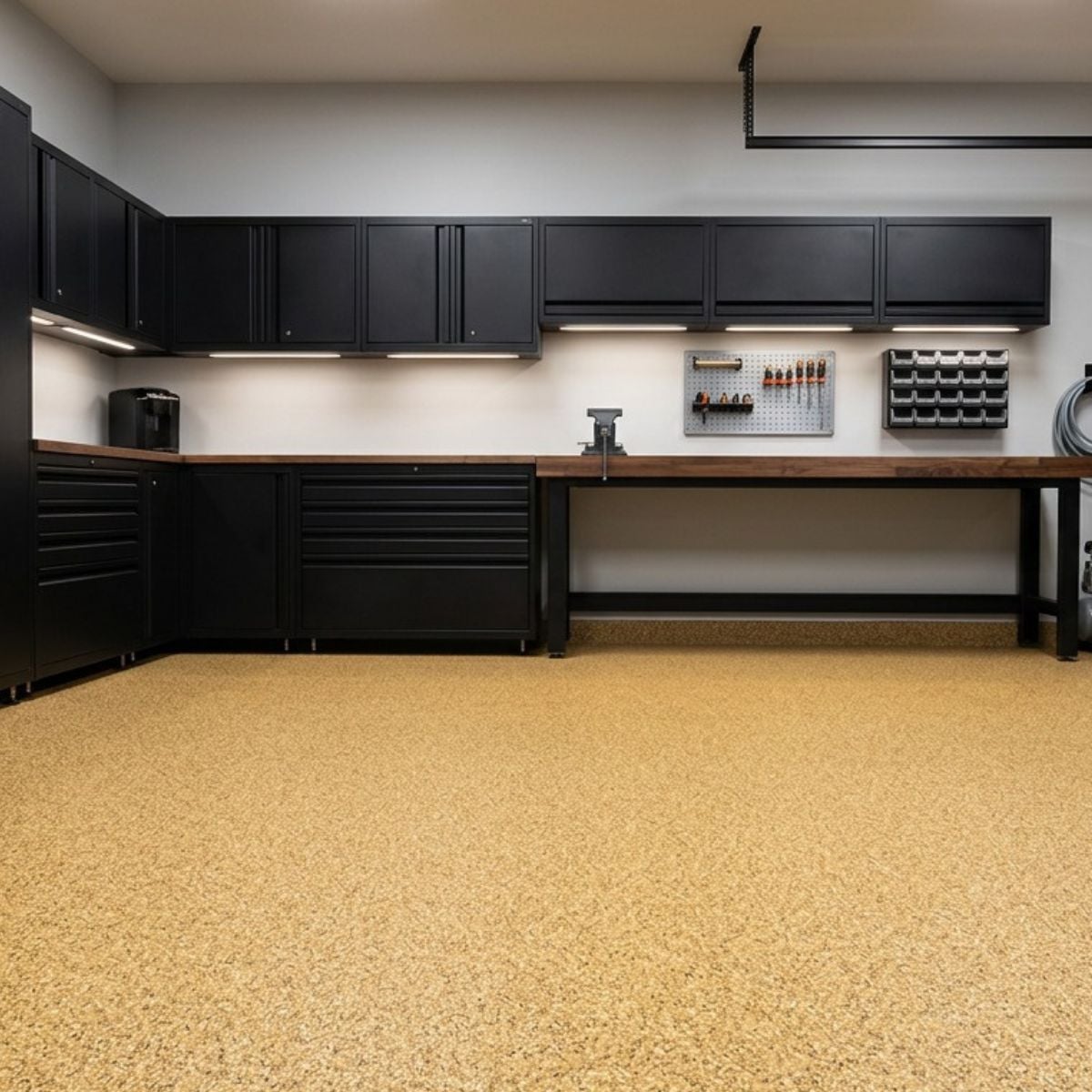
| Coronado / Caramel | Epoxy HP base coat + Polyaspartic 85 top coat | Caramel | Coronado | Base coat: 100 sq ft/gal (150 with primer) · Top coat: 125 sq ft/gal · Quartz broadcast: 1 lb/sq ft | 2–3 Days | From $800 |
| Medium Gray / Driftwood | Epoxy HP base coat + Polyaspartic 85 top coat | Driftwood | Medium Gray | Base coat: 100 sq ft/gal (150 with primer) · Top coat: 125 sq ft/gal · Quartz broadcast: 1 lb/sq ft | 2–3 Days | From $800 |
| Hazelnut / Red Tip | Epoxy HP base coat + Polyaspartic 85 top coat | Red Tip | Hazelnut | Base coat: 100 sq ft/gal (150 with primer) · Top coat: 125 sq ft/gal · Quartz broadcast: 1 lb/sq ft | 2–3 Days | From $800 |
| Pro Quartz Floor Systems — Polyaspartic 85 or Epoxy HP Base Coat + AU 85 Aliphatic Urethane Top Coat | ||||||
| Aztec Red / Sienna | Polyaspartic 85 or Epoxy HP base coat + AU 85 aliphatic urethane top coat | Sienna | Aztec Red | Base coat: 150 sq ft/gal (175 with primer) · AU 85 top coat: 125 sq ft/gal · Quartz broadcast: 1 lb/sq ft | 1 Day or 2–3 Days | From $824 |
| Champagne / Sagebrush | Polyaspartic 85 or Epoxy HP base coat + AU 85 aliphatic urethane top coat | Sagebrush | Champagne | Base coat: 150 sq ft/gal (175 with primer) · AU 85 top coat: 125 sq ft/gal · Quartz broadcast: 1 lb/sq ft | 1 Day or 2–3 Days | From $824 |
| Dark Walnut / Coffee | Polyaspartic 85 or Epoxy HP base coat + AU 85 aliphatic urethane top coat | Coffee | Dark Walnut | Base coat: 150 sq ft/gal (175 with primer) · AU 85 top coat: 125 sq ft/gal · Quartz broadcast: 1 lb/sq ft | 1 Day or 2–3 Days | From $824 |
| Sapphire Blue / Malibu | Polyaspartic 85 or Epoxy HP base coat + AU 85 aliphatic urethane top coat | Malibu | Sapphire Blue | Base coat: 150 sq ft/gal (175 with primer) · AU 85 top coat: 125 sq ft/gal · Quartz broadcast: 1 lb/sq ft | 1 Day or 2–3 Days | From $824 |
* Starting price reflects a 1-car garage (300 sq ft) with no primer coat. All systems require surface grinding to CSP-2 or CSP-3 profile before installation. Coverage rates are planning estimates and vary based on surface porosity, profile, and application conditions. Adding a primer coat increases base coat coverage to 150–175 sq ft/gal depending on the system.
Every quartz floor system on this page is built from the same core lineup of professional-grade materials. Understanding what each product does — and why it’s in the system — helps you make a more confident decision before you start.
- Polyaspartic 85 — A high-performance polyaspartic coating that works as both a base coat and a top coat. It has a quicker recoat time of 4–6 hours, higher UV and abrasion resistance, and won’t yellow over time. If you’ve done floor coatings before and want to finish in a single day, this is the go-to choice. Keep in mind that the material sets up quickly — on the floor and in the bucket — so being well-prepared before you start is important.
- Epoxy HP — A two-part epoxy base coat that gives you a longer working time on the concrete surface, making it more forgiving for first-time installers. It has a longer set time of 8–16 hours between coats, which lets you spread the work across two to three days without losing your bonding window. Epoxy will yellow over time if left exposed to UV, which is why a polyaspartic or aliphatic urethane top coat is always recommended over it.
- AU 85 (Aliphatic Urethane) — The highest-performing top coat available. It’s formulated to go on thicker without foaming and delivers superior protection against UV, abrasion, chemicals, and oil. It also has a longer working time, which makes it the most DIY-friendly top coat option if you want maximum durability. This is the choice for floors that need to hold up to real use over time.
- RZ Tint — A concentrated pigment added directly to your base coat resin after mixing. The recommended dose is 4 oz per gallon of resin. Always mix the resin fully first, then add the tint. The color of the base coat shows through the quartz broadcast in the joints and edges, and influences the overall tone of the finished floor.
- Decorative Quartz Granules — Applied in a full broadcast at 1 lb per square foot in two passes, throwing in opposite directions each pass. The first pass covers about 60% saturation, the second brings it to rejection. Quartz creates a very hard, rough surface with excellent slip and abrasion resistance — it’s one of the most durable broadcast options available.
- Essential Epoxy Primer — A thin primer coat applied before the base coat when your concrete is porous or has minimal moisture emission. It seals the air pockets in the concrete that would otherwise cause bubbling in your base coat. With a primer coat, your base coat covers 175 sq ft per gallon on quartz floors instead of 150 sq ft per gallon — the sealed surface means less material gets absorbed.
Not every system on this page requires the same level of experience. Here’s a straightforward breakdown to help you match the right system to your situation.
- 1-Day Polyaspartic Systems — Best suited for installers who have handled coatings before or are very well-prepared. Polyaspartic sets up fast — both in the bucket and on the floor — so you need to be ready to move. The payoff is a completed floor in one day with excellent UV and abrasion resistance built in from the start. If this is your first time, take extra time to read the installation guide and plan your sections before you open any containers.
- 2–3 Day Epoxy Systems — The more DIY-friendly option. Epoxy has a shorter pot life but a longer working time on the concrete surface, which means you have more time to spread and correct before it sets. You can comfortably split the work across two to three days while the bonding window stays open. A polyaspartic top coat is applied over the epoxy base to protect against UV yellowing and add abrasion resistance.
- Pro Systems with AU 85 Top Coat — These systems are built for floors that need to perform at the highest level. The AU 85 aliphatic urethane top coat outperforms all other options for UV, abrasion, chemical, and oil resistance, and its longer working time actually makes it easier to apply than polyaspartic as a top coat. You can choose either a polyaspartic or epoxy base coat depending on your timeline and experience level. Adding a primer coat is recommended for most concrete surfaces and increases your base coat coverage rate.
Regardless of which system you choose, surface preparation is the single most important factor in how your floor performs long-term. Grinding the concrete to the right profile — CSP-2 or CSP-3 — and removing all dust before coating is what determines whether the coating bonds and holds for years or fails early. No product on this page can compensate for inadequate prep.
All coverage numbers shown in the kit builder are planning estimates based on standard installation conditions at 70°F and 50% relative humidity. Your actual coverage will depend on several real-world factors, and it’s always better to order slightly more than you think you need than to run short mid-project.
- Surface profile — A more aggressively ground surface (CSP-3) has more texture and micro-valleys that absorb more material than a lighter profile (CSP-2). The rougher your floor, the more base coat it will take to achieve full coverage.
- Concrete porosity — If your concrete is highly porous — visually resembling foam or swiss cheese after grinding — it will absorb more material. Using a primer coat on porous concrete seals those voids and brings your effective coverage rate up significantly.
- Applicator tools — A notched squeegee controls thickness more precisely than a roller alone. Backrolling with a ¼” nap roller after squeegeeing helps redistribute material evenly. Using the wrong tool, or applying material unevenly, can result in thinner coverage in some areas and excess in others.
- Temperature and working conditions — Higher temperatures accelerate the set time of both epoxy and polyaspartic, which can affect how much material you’re able to spread from each batch before it becomes unworkable. Working in extreme heat without adjusting your batch size can lead to waste.
- Quartz broadcast — Coverage for quartz is planned at 1 lb per square foot for full broadcast. Actual usage can vary based on how evenly the material is thrown, the weight of each individual broadcast pass, and how much excess is swept and vacuumed off after curing.
When in doubt, order more. Leftover material stores well, and having extra on hand for touch-ups after scraping and vacuuming is always useful.
