Epoxy Floor Coating Calculator
Configure every layer of your floor coating system — choose your finish style, base coat resin, primer, broadcast media, and top coat. Get exact material quantities calculated for your floor size and add everything to your cart in one place. Works for garage floors, basements, workshops, and commercial spaces.
Your floor preview will appear here as you make your selections
Floor Type
Choose your finish style — this shapes the whole system
Base Color
Choose your RZ Tint — added to the base coat
Base Coat Resin
Choose your resin — this determines your timeline
Primer Coat
Seals porous concrete and prevents bubbling
Top Coat
Final protective layer — choose your performance level
Second Top Coat Optional
Add a second layer for more protection or a satin finish
Floor Size
Enter your square footage to calculate materials
Your Material List
Calculated quantities for your exact floor size
Frequently Asked Questions — Epoxy Floor Coatings, Systems & Materials
What is the difference between epoxy and polyaspartic floor coating?
Both are two-part resin systems that bond chemically to concrete — neither one is paint. The differences come down to cure time, UV stability, and working time. Epoxy HP has a longer working time on the concrete surface, making it more forgiving for first-time installers. But epoxy will yellow over time when exposed to UV light, which means it needs a polyaspartic or aliphatic urethane top coat to protect it in any space with natural light. Polyaspartic 85 sets up in 4–6 hours, doesn’t yellow, and has better abrasion and UV resistance built in. For most garage floor and residential applications, polyaspartic is the better base coat because it completes faster and doesn’t require a protective top coat to maintain its appearance. Epoxy is a strong choice for poured base coats in 2–3 day systems or for interior spaces with zero UV exposure.
What are the different types of concrete floor coating systems — and which is right for my space?
There are four main finish styles available on this page, each suited to different priorities.
Solid color — the simplest system. Two coats of tinted Polyaspartic 85 and you’re done. Best for workshops, utility rooms, basements, and any space where a clean, uniform background matters more than texture. A solid floor makes dropped hardware and small parts visible immediately, which is a practical advantage in working garages. No broadcast step, no scraping, no vacuuming.
Vinyl chip (flake) — the most popular DIY garage floor coating. A tinted base coat with 1/4″ vinyl chips broadcast into it creates a floor with excellent chip coverage, slip resistance, and a finish that hides tire marks, minor scuffs, and surface variation better than any other system. Can be done in 1 day with polyaspartic or 2–3 days with epoxy.
Quartz — harder, heavier, and more abrasion-resistant than vinyl chips. Quartz granules are broadcast at 1 lb per square foot and create a very rough, durable surface that holds up to heavy traffic and harsh conditions. More difficult to broadcast evenly than chips, but the result is the most durable decorative floor available.
Metallic — the most visually dramatic option. Tru Lustre Metallic Pigment is mixed into an epoxy base coat and worked into flowing patterns while the resin is wet. No two metallic floors look alike. Best for showrooms, home theaters, reception areas, and spaces where the floor is a design statement.
Do I need a primer coat?
It depends on your concrete. Primer is not always required — but it’s almost always the right call. A primer coat seals air pockets in the concrete that would otherwise rise into the base coat and create bubbles on the surface. On porous concrete (which visually resembles swiss cheese or foam after grinding), primer is essential. It also provides protection against minor moisture emission from the slab. The practical benefit beyond adhesion is coverage rate: a primed surface allows your base coat to cover 150–175 sq ft per gallon instead of 100 sq ft per gallon, which significantly reduces the total amount of base coat you need on larger floors. If your concrete is dense, has been recently ground, and shows no moisture, skipping primer is acceptable. If you have any doubt, add the primer — it’s inexpensive relative to the rest of the system and the insurance it provides is real.
What is the difference between vinyl chips and quartz broadcast?
Both are broadcast into a wet base coat and create decorative, slip-resistant floors — but they behave very differently in application and performance. Vinyl chips are larger, lighter, and flutter as they fall, which makes them easier to distribute in a natural random pattern. They’re the more beginner-friendly broadcast option and by far the most popular for DIY garage floors. Quartz granules are smaller, heavier, and fall in the exact direction you throw them, which means technique matters more — uneven throws can create visible streaks or blobs. Quartz creates a harder, rougher surface and requires 1 lb per square foot (significantly more material than chips), but the resulting floor is more resistant to abrasion and heavy traffic. Quartz is always a full broadcast. Vinyl chips can be full broadcast (covering the floor completely) or partial broadcast (a decorative scatter that leaves the tinted base coat showing through as part of the design).
How does RZ Tint work and how does color change the look of a floor?
RZ Tint is a concentrated pigment that mixes directly into polyaspartic or epoxy resin before application. On its own, both resins are clear — the tint is what gives the floor color. The dose varies by system: chip and quartz floors use 2 oz per gallon of base coat (lighter dose because chips cover most of the color anyway), solid color floors use 6 oz per gallon (heavier dose for full opacity with no chips hiding the base), and metallic systems use 4 oz per gallon added to the primer coat. The tint color creates the underlying tone of the floor — for chip and quartz floors, it shows through in the joints between broadcast pieces and along edges, which is what gives the floor its overall color impression. Choosing a tint that complements the broadcast color is as important as the broadcast choice itself. Cool gray tints under chip blends like Earl Grey or Neutral read as sophisticated and clean. Warm amber tints under Autumn or Pumpkin chips feel energetic and dynamic. Solid color floors in deep saturated tones like Emerald or Sapphire Blue can transform a raw garage or basement into a dramatically finished space.
What top coat should I use and do I need more than one layer?
The top coat is the final protective layer that determines long-term durability and sheen. AU 85 (Aliphatic Urethane) is the highest-performing option — it resists UV, abrasion, chemicals, and oil, goes on thicker without foaming, and has a longer working time that makes it easier to apply evenly. It’s the right choice for any floor that will see real use. Polyaspartic 85 is a strong UV-stable top coat with a faster 4–6 hour cure time — a good match if you’re using poly as your base coat and want to stay in the same product family. Epoxy HP as a top coat is only appropriate for indoor spaces with no natural light. WBU M is the only low-sheen (satin) option available — if you want a floor that doesn’t look like a mirror, WBU M is your choice. WBU G is the high-gloss water-based urethane alternative with excellent protection. For quartz floors, a single top coat layer is the standard — adding more layers starts to fill in the texture and reduces traction. For chip and quartz floors with heavy commercial use, or any time you want a satin finish, a second top coat layer adds meaningful additional protection.
How do I calculate how much epoxy or polyaspartic I need for my floor?
The calculator above handles this automatically once you select your floor type, base coat, primer choice, and floor size. But understanding the underlying numbers helps you verify the output and plan accurately. Coverage rates depend on three variables: the product, the system, and whether you used a primer coat. As a general reference — without primer, a polyaspartic or epoxy base coat on a chip floor covers 100 sq ft per gallon. With primer, that improves to 150 sq ft per gallon. Quartz floors cover 150 sq ft per gallon without primer and 175 with primer. Metallic base coats are applied thicker at 75 sq ft per gallon. Top coats cover more ground: 175 sq ft per gallon for chip floors, 125 sq ft per gallon for quartz, and 250–300 sq ft per gallon for metallic. These are planning estimates at 70°F and 50% humidity — porous or aggressively ground concrete will absorb more material. Always order slightly more than the calculated minimum.
Choosing Your Floor Coating System — A Visual Guide
Every floor coating on this page starts with the same core products — a resin base coat, RZ Tint pigment, and a protective top coat. The finish style determines everything else: how long installation takes, how much material you need, how the floor performs, and how it looks. Here’s what each system looks like in practice.
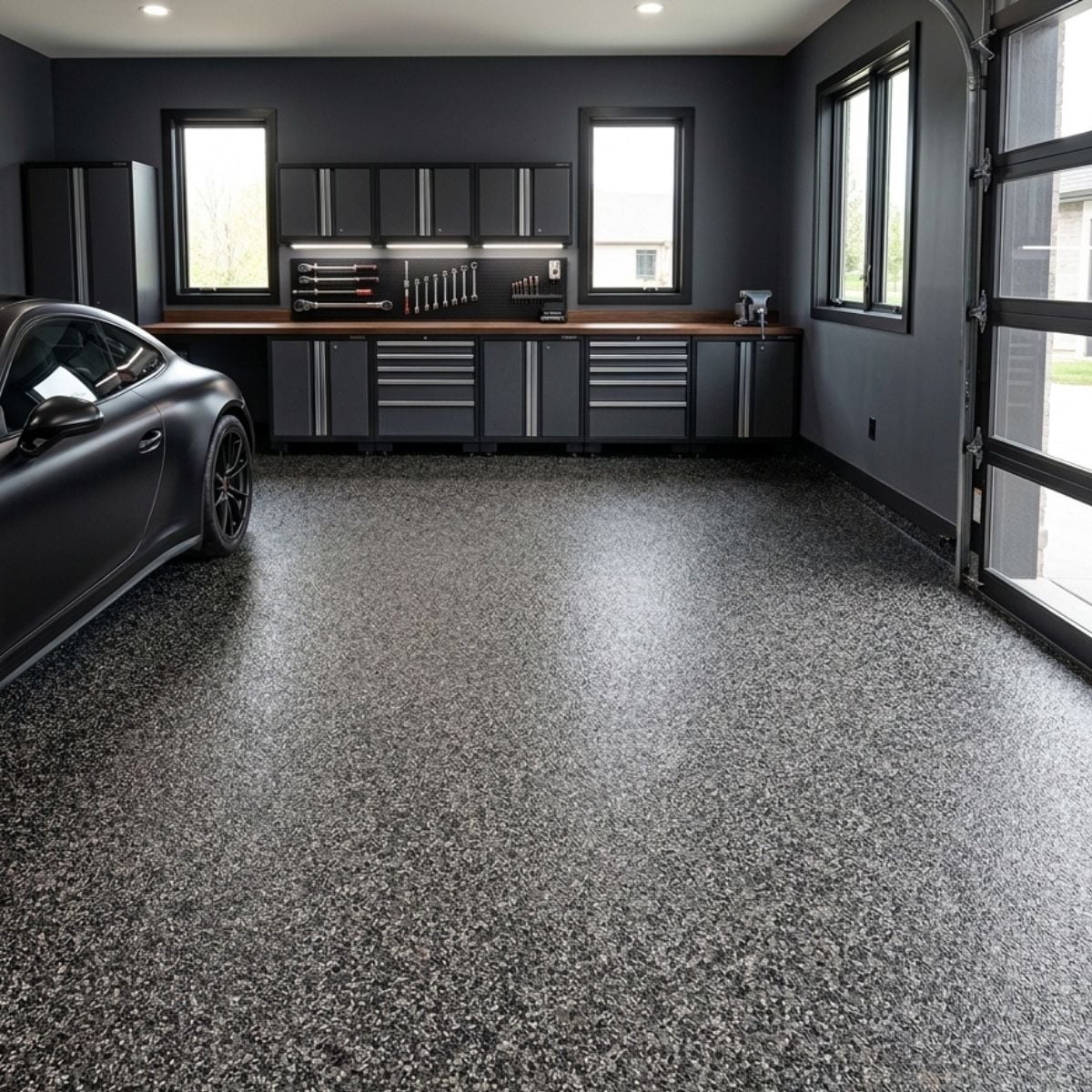
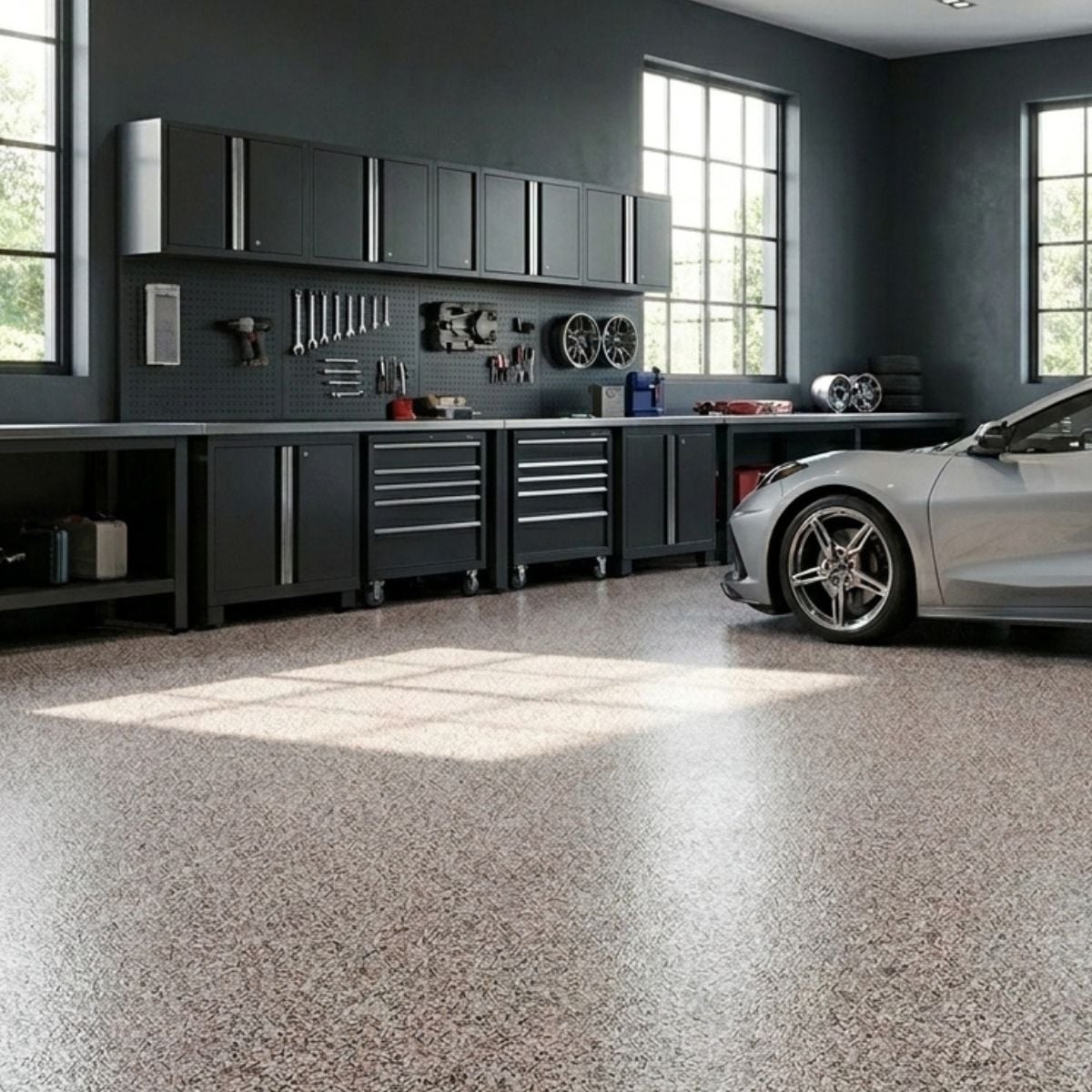
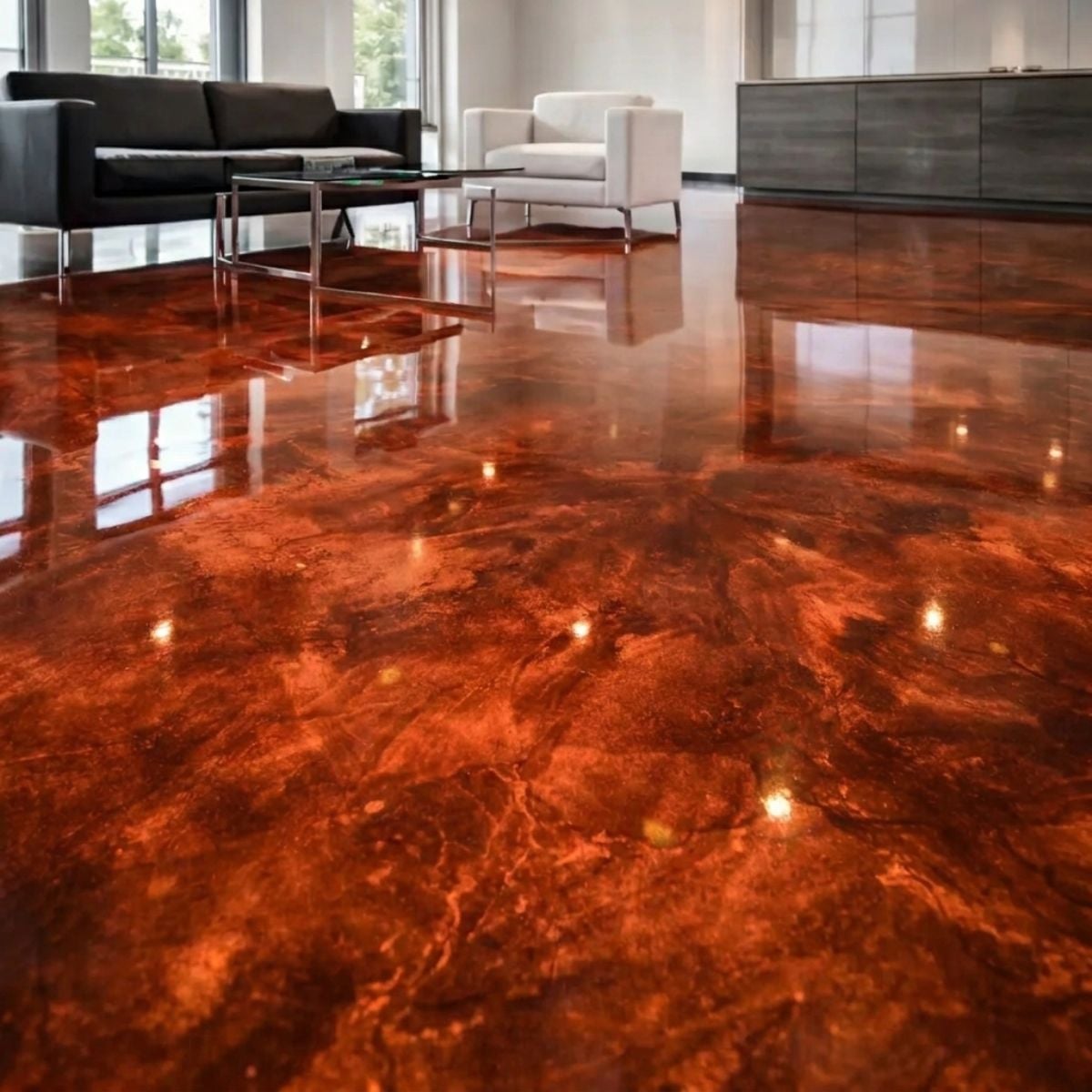
| System | Best For | Timeline | Difficulty | Durability |
|---|---|---|---|---|
| Solid Color | Workshops, utility rooms, basements — spaces where you work and need visibility | 1 Day | Easiest — no broadcast step | Good for normal use, lighter than broadcast systems |
| Vinyl Chip | DIY garages, rec rooms, commercial spaces — most popular overall | 1–3 Days | Beginner-friendly — chips are forgiving to broadcast | Excellent with polyaspartic or AU 85 top coat |
| Quartz | High-traffic garages, commercial floors, heavy-use spaces | 1–3 Days | Moderate — quartz broadcast requires technique | Highest of any decorative system — very hard surface |
| Metallic | Showrooms, home theaters, design-focused spaces | 2–3 Days | Advanced — artistic technique required | Excellent with AU 85 or polyaspartic top coat |
For more detail on each system, browse by floor type: Vinyl Flake Flooring Kits · Quartz Floor Coating Kits · Epoxy Metallic Flooring Kits · Solid Color Epoxy Floor Kits
Vinyl Chips vs. Quartz — Choosing Your Broadcast Media
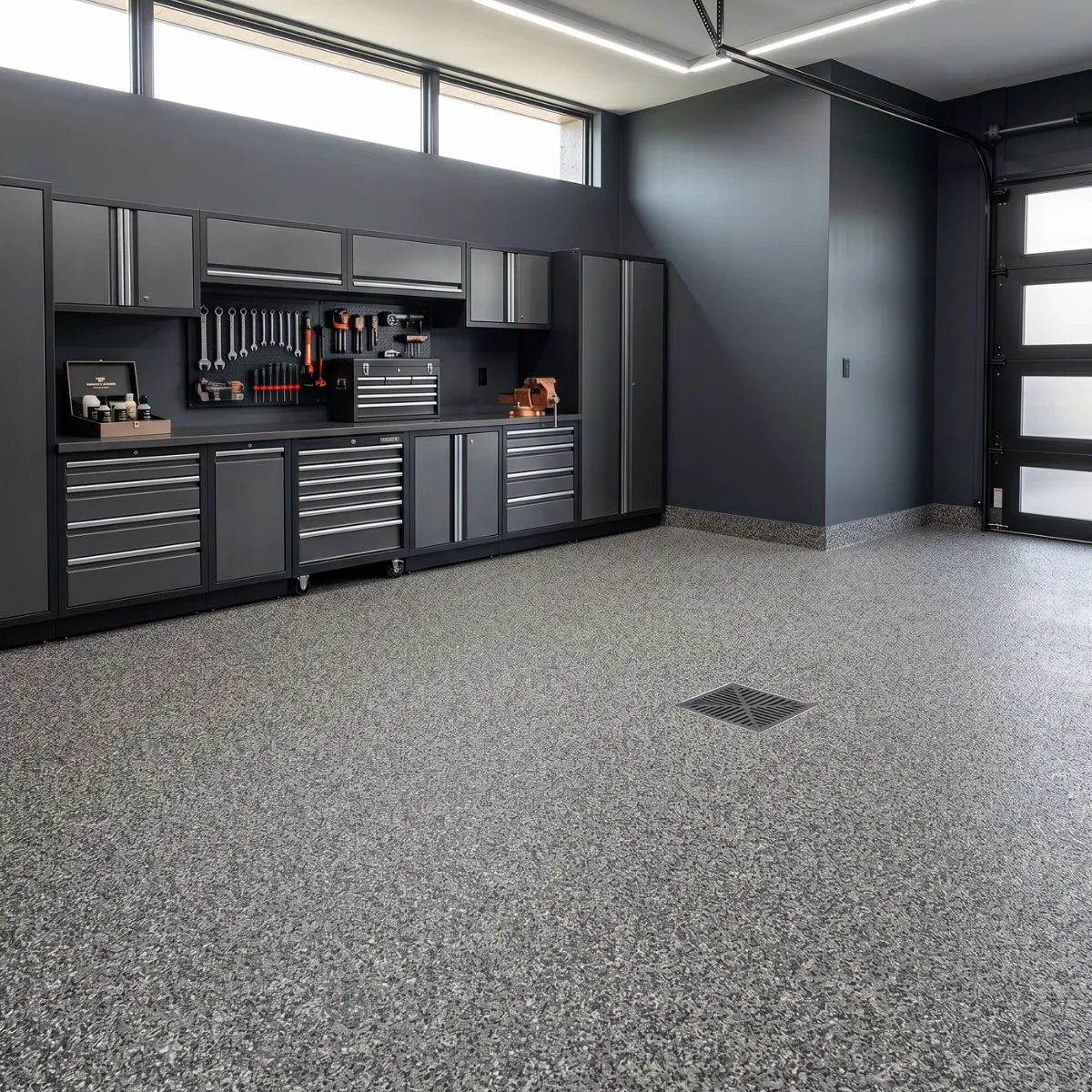
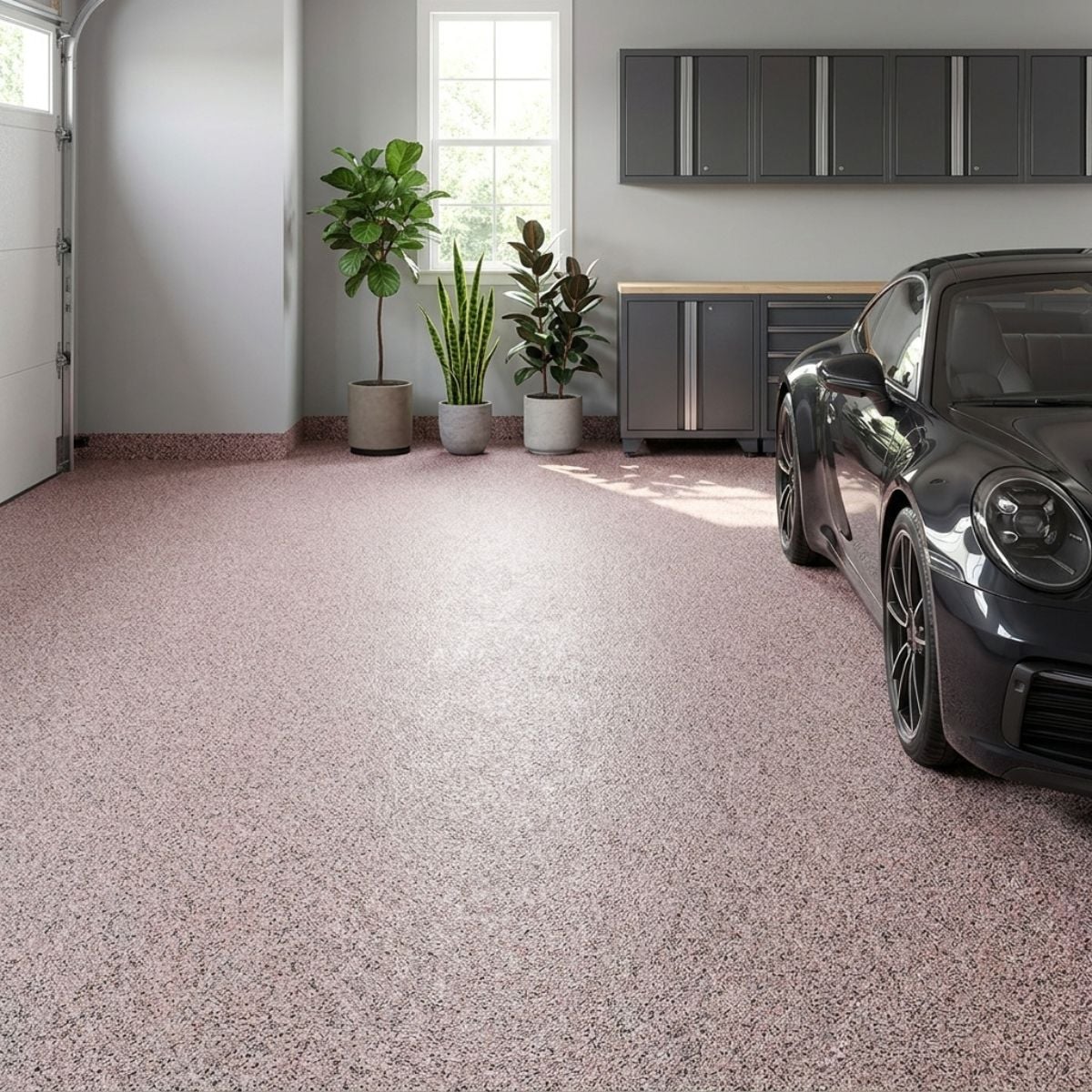
Vinyl chips and quartz granules both get broadcast into a wet base coat, scrape and vacuum off after curing, and receive a top coat over them. The end results look different, perform differently, and install differently.
Vinyl Chips
Vinyl chips are larger, lighter, and flutter as they fall — which means they naturally land in a random, non-directional pattern that’s easy to achieve without specialized technique. You broadcast them by taking handfuls and throwing them upward and outward, continuing until the chips cover the floor completely (full broadcast) or until you like how it looks (partial broadcast). Plan for approximately 8 sq ft per pound at full coverage, though real-world usage ranges from 5 to 10 sq ft per pound depending on chip size and throw. The base coat color shows through between chips and along edges, which is why matching your RZ Tint to the chip blend is an important design decision. For a 1-car garage (300 sq ft), a full broadcast typically requires 2 boxes.
Quartz Granules
Quartz granules are smaller, denser, and fall in the exact orientation they leave your hand. This means broadcast technique matters significantly — the granules need to be agitated as they leave your hand to create the even “raining” effect that produces a uniform surface. Quartz is always applied at full broadcast in two passes: the first covering about 60% of the surface, the second bringing it to rejection (where additional quartz just sits on top rather than embedding). Plan for 1 lb per square foot, meaning a 300 sq ft garage requires approximately 300 lbs (six 50 lb bags). The resulting surface is extremely hard and rough — more abrasion and slip-resistant than vinyl chips. For high-traffic garages, commercial spaces, or floors that need to perform at the highest level, quartz is the right choice.
How Floor Color Changes a Space
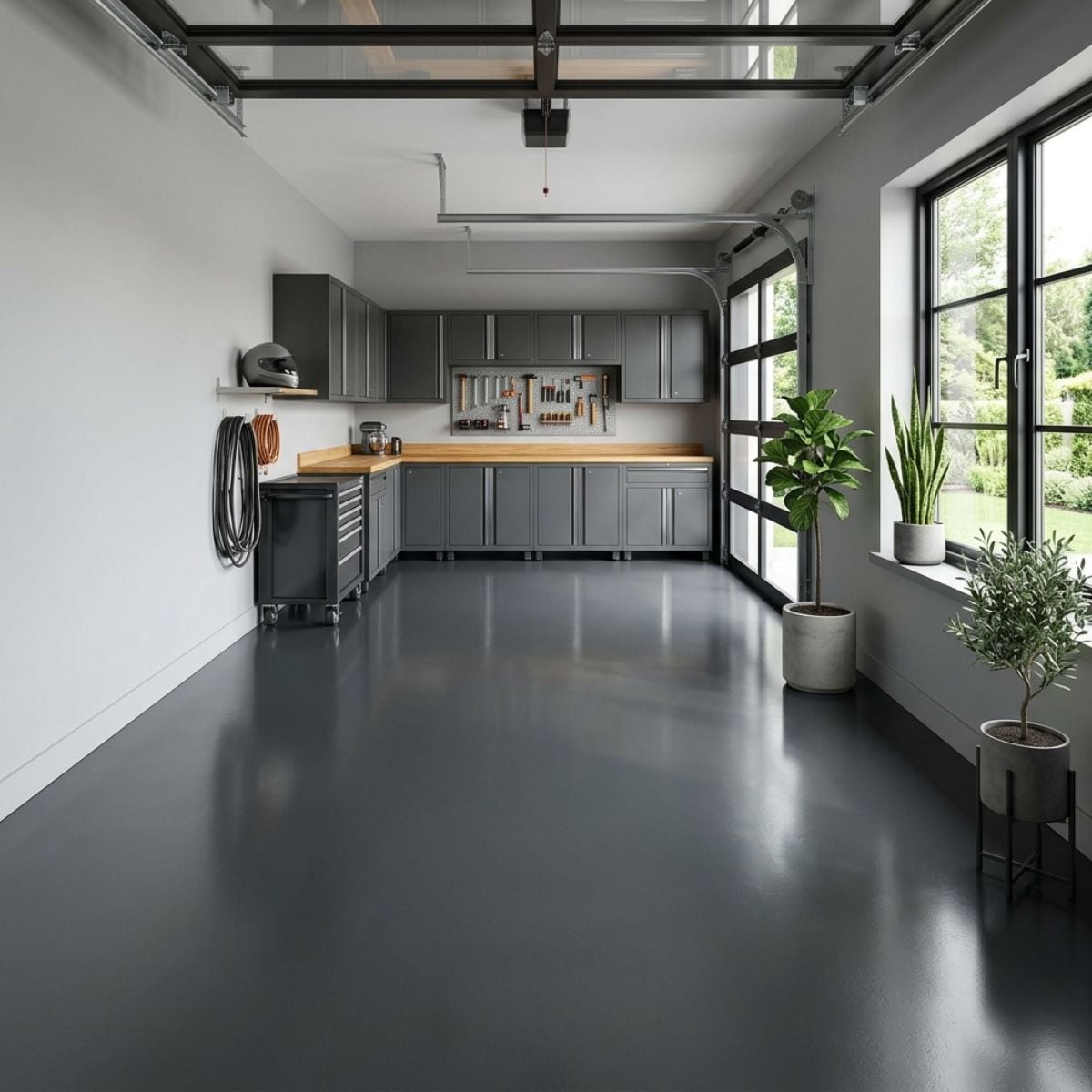
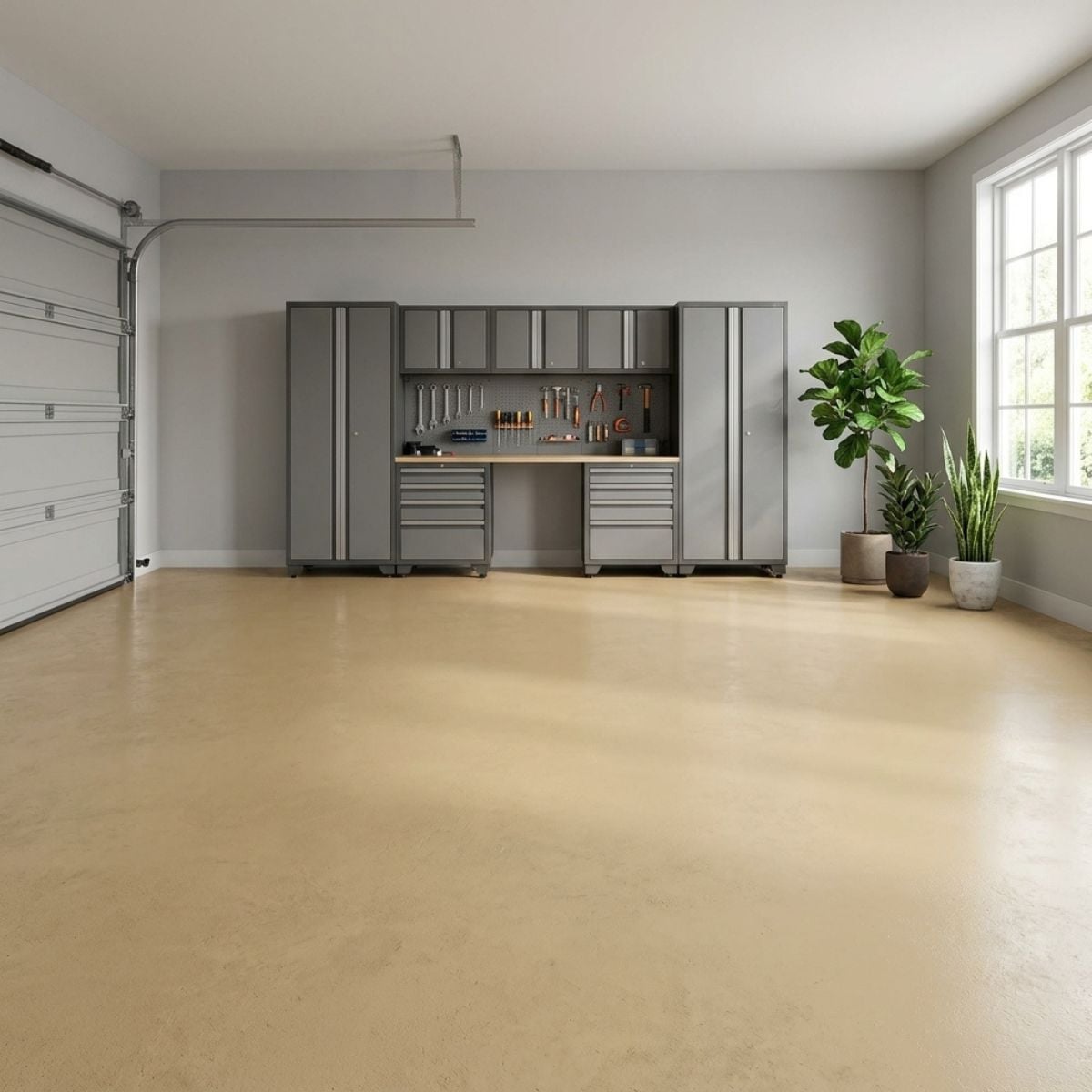
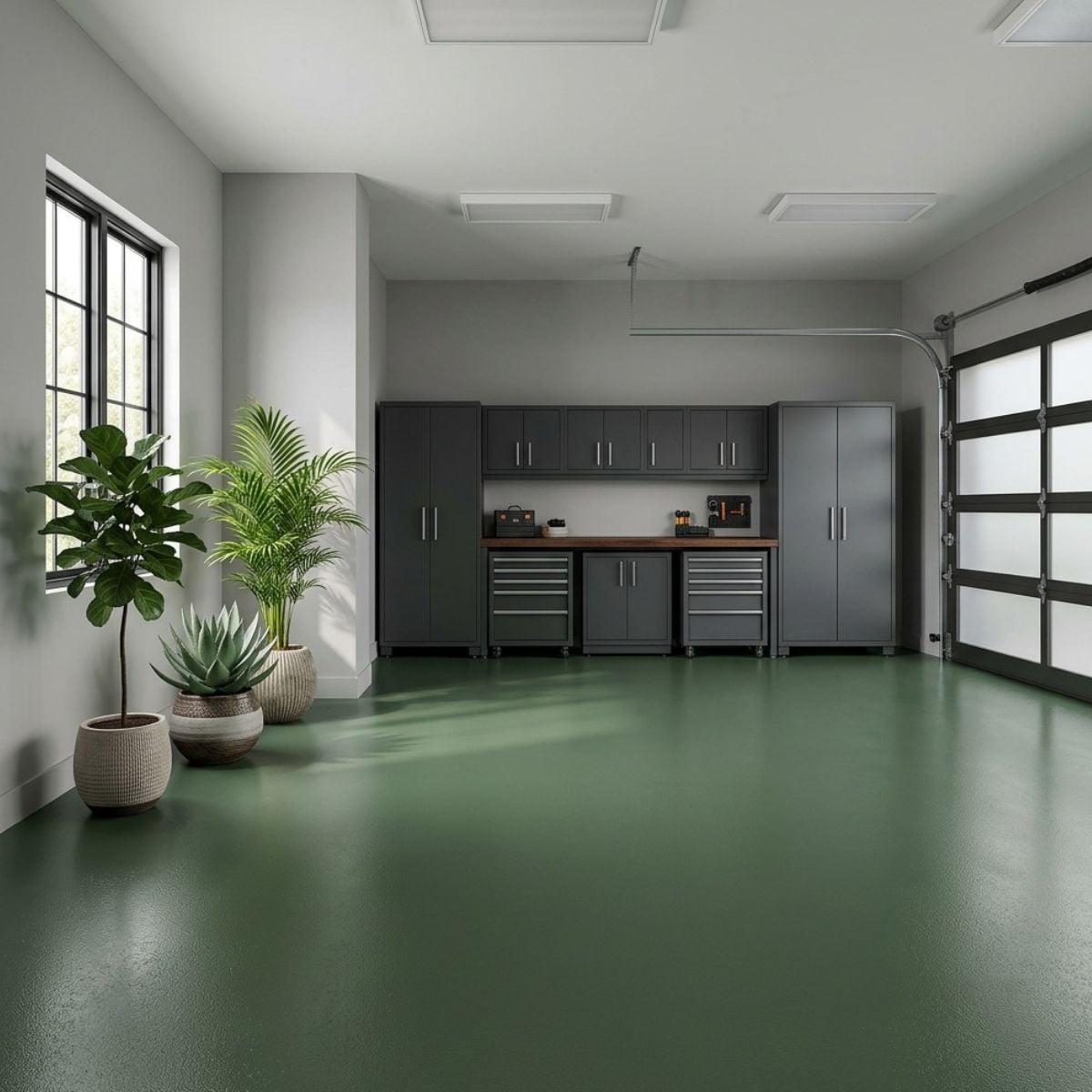
Floor color has more impact on how a space feels than most people expect. A dark floor — charcoal, black, deep walnut — makes a garage feel intentional and serious. It reads as clean even when it’s not, because minor dust and debris don’t show against a dark background. A light floor — gray, champagne, whey — opens up the space visually and makes it feel larger and brighter. It reflects more light, which can make a difference in garages and basements where natural light is limited. Bold saturated colors — emerald, sapphire blue, aztec red — are design statements. They transform a utilitarian space into something that expresses a specific character. Safety yellow and safety red serve a functional purpose in commercial or industrial environments where zone marking and visual communication matter.
For chip and quartz floors, the RZ Tint color you choose for the base coat is what sets the underlying tone of the finished floor — even though most of the base coat is hidden under the broadcast material, the color shows through at the joints and edges and strongly influences the overall color impression. Matching a warm tint to warm chips (hazelnut under earthen chips, coronado under pumpkin chips) creates a cohesive, natural result. High contrast pairings (black tint under gray chips) produce a floor with more visual depth and definition.
Understanding Primer Coats — When You Need One and Why
A primer coat is a thin layer of resin applied before the base coat. It seals the surface of the concrete, eliminates air pockets that would bubble up into the base coat, and provides a stable bonding surface. For most concrete, adding a primer coat is the right call — it’s cheap insurance against one of the most common coating failures.
When primer is essential
If your concrete looks porous after grinding — visually resembling swiss cheese or open-celled foam — primer is mandatory. Porous concrete is full of small voids that trap air. Without primer, the base coat sits above these pockets, and as the resin cures and the surface heats up, the trapped air rises into the coating and creates craters and bubbles that can’t be fixed without removing the coating. A primer coat seals those voids so air can’t escape into the base coat.
Primer is also the recommended choice when your concrete shows any signs of moisture emission. The plastic sheet test — tape a piece of clear plastic to the slab for 24 hours and check for condensation — will tell you whether moisture is present. Minimal moisture can be managed with a standard primer coat. Heavy moisture emission requires a dedicated vapor barrier epoxy primer before the system primer.
The coverage rate benefit
Beyond adhesion, primer changes your coverage math. On a chip floor, a primed surface allows the base coat to cover 150 sq ft per gallon instead of 100 sq ft per gallon. On a quartz floor, 175 sq ft per gallon instead of 150 sq ft per gallon. On a larger floor, this difference can reduce your base coat material cost enough to offset the cost of the primer entirely — and you get better adhesion as a bonus.
Primer product options
Essential Epoxy Primer is the standard choice — it works with any base coat (epoxy or polyaspartic) and is specifically formulated for high adhesion on concrete. Polyaspartic 85 can also be used as a primer when using a polyaspartic base coat — it has a faster recoat window of 4–6 hours versus 8–12 hours for the epoxy primer, which helps if you’re trying to complete the project in a single day. For metallic floors, primer is not optional — it is required for every metallic system to prevent bare concrete from showing through the translucent metallic layer.
Coverage Rate Reference — Planning Your Material Order
All coverage numbers are planning estimates based on application at 70°F and 50% relative humidity. Your actual coverage will vary based on concrete surface profile, porosity, application tools, and working conditions. Always plan for slightly more material than your calculation requires.
| Product | Application | Without Primer | With Primer |
|---|---|---|---|
| Polyaspartic 85 / Epoxy HP | Base coat — chip or solid floor | 100 sq ft/gal | 150 sq ft/gal |
| Polyaspartic 85 / Epoxy HP | Base coat — quartz floor | 150 sq ft/gal | 175 sq ft/gal |
| Epoxy HP | Base coat — metallic floor | 75 sq ft/gal | 75 sq ft/gal (primer required) |
| Essential Epoxy Primer / Polyaspartic 85 | Primer coat — chip or quartz floor | 250 sq ft/gal | |
| Polyaspartic 85 | Primer coat — solid color floor | 300 sq ft/gal (thin coat, no tint) | |
| AU 85 / Polyaspartic 85 / Epoxy HP | Top coat — chip floor (full broadcast) | 175 sq ft/gal | |
| AU 85 / Polyaspartic 85 / Epoxy HP | Top coat — quartz floor | 125 sq ft/gal | |
| AU 85 / Polyaspartic 85 / Epoxy HP | Second top coat (all systems) | 250 sq ft/gal | |
| WBU M / WBU G | Top coat or second coat (all systems) | 200 sq ft/gal · 2 coats recommended | |
| RZ Tint | Added to chip/quartz base coat | 2 oz per gallon of base coat · 6 oz containers | |
| RZ Tint | Added to solid color coat | 6 oz per gallon of color coat · 6 oz containers | |
| Tru Lustre Metallic Pigment | Added to metallic base coat | 4 oz per gallon of base coat · 6 oz containers | |
| Vinyl Chips | Full broadcast | ~8 sq ft per lb · 25 lb boxes | |
| Quartz Granules | Full broadcast | 1 lb per sq ft · 50 lb bags | |
